
Cornell is spearheading the development and refinement of AI through extensive interdisciplinary collaborations.
Want your news listed here? Email us.
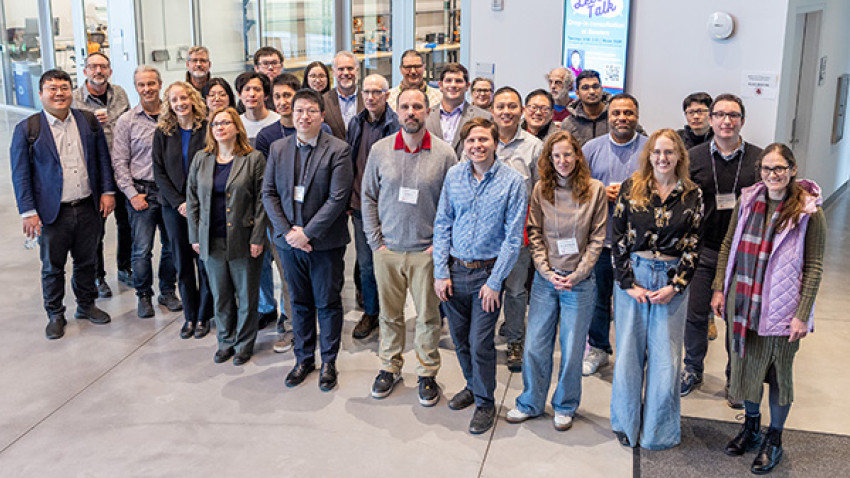
‘Wild west’ era of GenAI poses opportunities and challenges for science
Experts discussed the good, the bad and the unknown ways that GenAI is transforming science at the Assessing and Imagining the Impact of Generative AI on Science Symposium.

AI turns electron microscopy into materials insights in minutes
An autonomous artificial intelligence platform developed at Cornell streamlines materials research by quickly identifying key features in a microscopy image.

Cornell Tech partners with Mastercard to advance AI governance standards
Cornell Tech has launched a research collaboration with Mastercard to advance methods for evaluating and auditing generative artificial intelligence systems.
CAROW Announces AI and Work Grant Recipients
The ILR School’s Center for Applied Research on Work (CAROW) recently awarded three seed grants for new research that addresses questions around the intersection of AI and organizations, employment and work.

AI tools show promise for diagnosing advanced heart failure
The study offers the prospect of better care for many thousands of patients who may be overlooked due to the difficulty of diagnosing their condition.
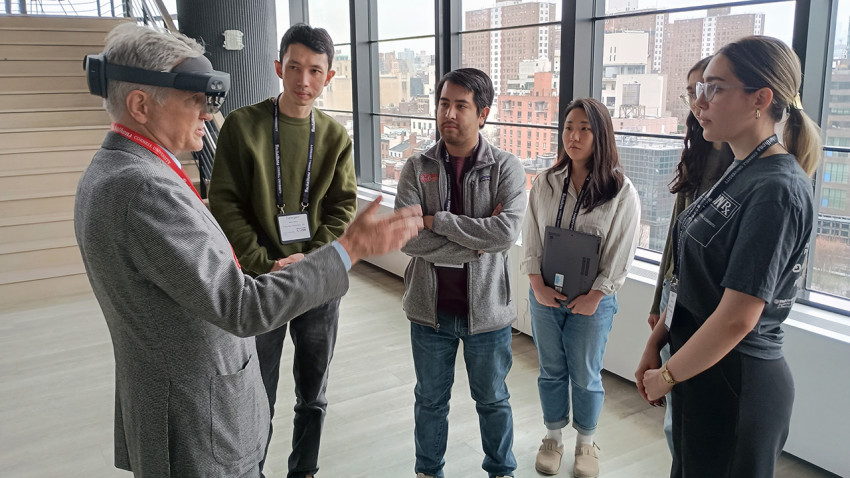
Students pitch AI-inspired solutions at Cornell Health Hackathon
More than 100 students from across Cornell campuses and 17 other universities gathered March 6-8 in New York City for an AI hackathon.

AI on deck: assessing impact of MLB’s new ball-strike system
Major League Baseball is instituting a major change this season, and it has inspired Cornell researchers to study how stakeholders are integrating the Automated Ball-Strike System, or ABS, into baseball’s sacred gameplay.

AI assistants can sway writers’ attitudes, even when they’re watching for bias
Cornell Tech researchers found that writers who used biased AI auto-suggestions saw their views gravitate toward the AI’s positions without their realizing it — even when they were made aware of the biased AI.

Testing large language models on scientific literature
Cornell physicists and Google researchers engaged a panel of 12 human experts to test the ability of six LLM systems to understand scientific literature at the level of a specialist.