
Latest stories, updates, and announcements that highlight the people, research, and progress of AI throughout Cornell.
Want your news listed here? Email us.
AI Headlines from Around the University

Via:
New CoPAIR program connects Cornell researchers with AI tools, training and community
October 26, 2026
The new Communities of Practice for AI-enabled Research (CoPAIR) program gives researchers access to emerging AI tools, hands-on training and collaborative communities where they can share best practices, develop disciplinary norms for appropriate AI use and non-use, and evaluate new tools for research.

Via:
‘A seat at the table’: Cornell expands access to multiple AI tools for faculty, staff, students
October 26, 2026
Most faculty, staff and students will have free access to a range of AI platforms – an effort to level the playing field, spur exploration and reduce the costs and vulnerabilities of individual consumer licenses.
Via:
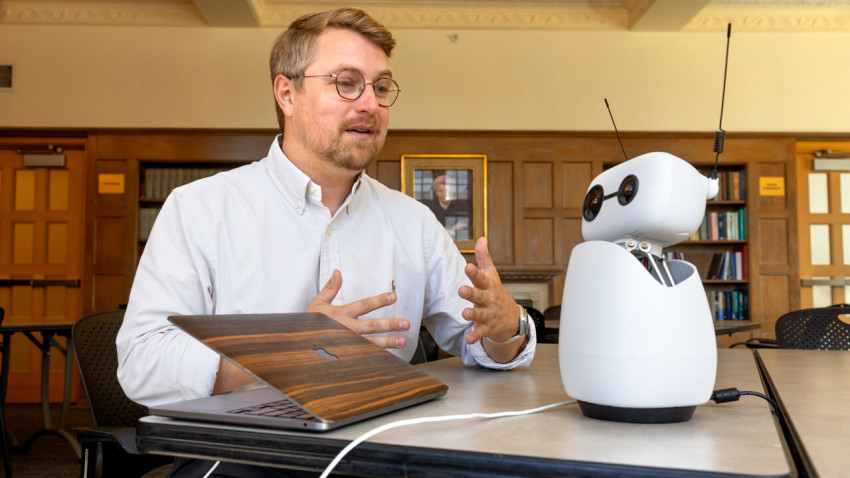
Cute robots, historical chatbots: AI in the classroom grows more sophisticated
October 22, 2026
Instructors across Cornell are working to strike a balance in the classroom – using AI as a teaching tool but also making choices to prevent its use and preserve the learning experience.

Via:
Cornell Bowers launches two online master’s programs in AI
October 21, 2026
Starting in fall 2027, working professionals can pursue a master’s degree in AI or applied AI.

Via: Marketplace
Should You Use AI for Election Research?
October 20, 2026
David Rand offers advice on how voters can use AI as an informational assistant for election research.

Via:
Any student, any major: ‘Everyday AI’ course to launch spring 2027
October 19, 2026
In spring 2027, Cornell Bowers will launch a new course that is open to all entitled, “Everyday AI: Learning to use AI effectively and responsibly.”

Via:
Air Force award supports research into resilient spacecraft coordination
October 19, 2026
Gregory Falco, assistant professor, has received a Young Investigator Program award from the Air Force Office of Scientific Research to investigate autonomous spacecraft that can maintain coordination while an adversary is trying to disrupt them.

Via:
Grant aims to improve AI models of human choices in complex systems
October 19, 2026
A National Science Foundation grant will support Cornell research aimed at developing AI models that can better represent human decision-making in cyber-physical systems while remaining interpretable and explicit about uncertainty.

Via:
Who is Elias the lighthouse keeper? AI fiction tells the same old story
October 19, 2026
For AI agents instructed to write fiction, that tale usually involves lighthouses and a keeper named Elias, according to new Cornell research.