
Latest stories, updates, and announcements that highlight the people, research, and progress of AI throughout Cornell.
Want your news listed here? Email us.
AI Headlines from Around the University

Via:
Generative AI critical literacy pilot launched this spring
February 3, 2026
Since ChatGPT burst onto the scene, higher education has been grappling with the impact of Generative AI on research, teaching, learning, and work. In the Spring of 2025, Cornell University Library and the Center for Teaching Innovation began discussions around how to address AI literacy, which is the understanding, use, and critical evaluation of artificial intelligence.

Via:
Four on faculty to receive DOE early-career grants
February 3, 2026
Four Cornell faculty members are among 99 researchers across the U.S. who have been awarded grants by the U.S. Department of Energy as part of its Office of Science Early Career Research Program.
Via:
Three early-career professors win NSF development awards
January 29, 2026
Cornell researchers studying microplastics, robotics and machine learning are recent recipients of National Science Foundation Faculty Early Career Development Awards.

Via:
Thorsten Joachims named vice provost for AI strategy
January 27, 2026
Thorsten Joachims has been named vice provost for artificial intelligence strategy, a newly created position intended to bolster the Cornell AI Initiative. This new position further expands Cornell’s universitywide effort to advance leadership in research and education in AI, while creating, applying and evaluating AI as a tool across the university – from classrooms and laboratories to clinics and university processes. His appointment took effect Jan. 1.

Via:
Wilkens receives Schmidt Sciences award for humanities research
January 20, 2026
A research group led by Matthew Wilkens, associate professor of information science in the Cornell Ann S. Bowers College of Computing and Information Science, is the recent recipient of a Schmidt Sciences award to leverage AI in the humanities to unlock new insights in human history and culture.
Via:
MathGPT founders say site boosts students’ skills, confidence
January 16, 2026
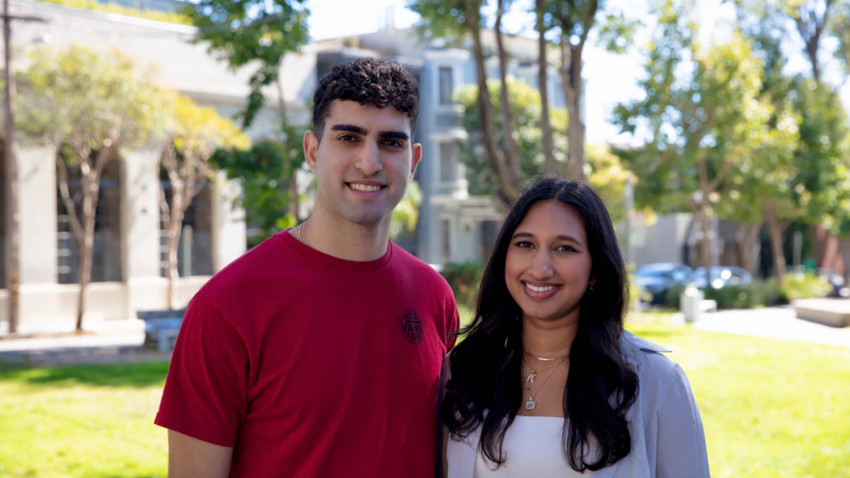
The founders of MathGPT are featured on the January episode of the Startup Cornell podcast.

Via:
‘Rosetta stone’ for database inputs reveals serious security issue
January 13, 2026
The data inputs that enable modern search and recommendation systems were thought to be secure, but an algorithm developed by Cornell Tech researchers successfully teased out names, medical diagnoses and financial information from encoded datasets.

Via:
AI improves flood projections under climate change
January 8, 2026
Physics-based models should be supplemented with AI hydrological models rather than relying on site-specific estimates, researchers find.

Via:
Computer vision connects real-world images with building layouts
December 22, 2025
A Cornell research team has introduced a new method that helps machines make connections between what’s on the ground and how it represented on a map – an advance that could improve robotics, navigation systems and 3D modeling.