
Latest stories, updates, and announcements that highlight the people, research, and progress of AI throughout Cornell.
Want your news listed here? Email us.
AI Headlines from Around the University

Via:
As Empire AI dawns, Cornell lays groundwork for public good
April 22, 2024
Empire AI, a $400 million effort to create a shared academic research computing facility, is set to advance dozens of ambitious, cross-disciplinary projects at Cornell.

Via:
Cornell Bowers CIS to launch minor in artificial intelligence
April 19, 2024
Beginning Fall 2024, Cornell undergraduates can minor in artificial intelligence (AI).

Via:
AI-powered ‘sonar’ on smartglasses tracks gaze and facial expressions
April 10, 2024
Cornell researchers have developed two technologies that track a person’s gaze and facial expressions through sonar-like sensing.
Via:
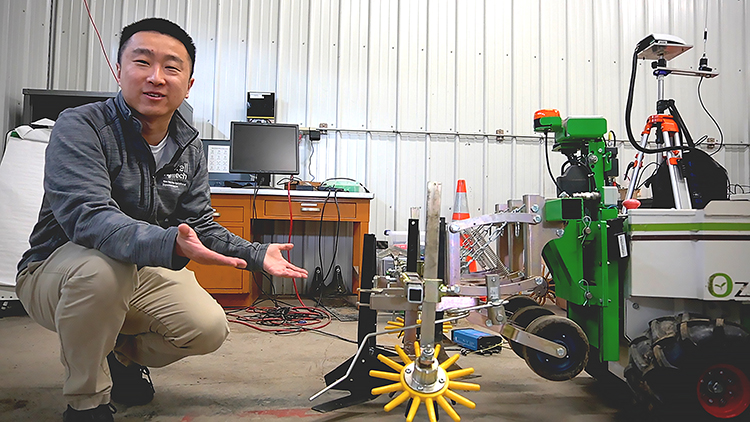
Scientists Harness Robots and AI to Revolutionize Farming
April 4, 2024
Yu Jiang is taking ag research to the next level. From robots to drones to AI, Yu is developing many exciting solutions for the New York farm industry.

Via:
Statistical machine learning finds unknown factors that underlie disease
March 27, 2024
A new method can now find previously unknown factors that underlie disease by using statistical machine learning to sort through mountains of complex biological data.

Via:
Worker mobility can impact adoption of new technology
March 27, 2024
New research suggests that when workers have more ability to find a new employer, businesses face higher risks of losing skilled employees who possess the expertise needed to implement new technologies, including machine learning.

Via:
Faculty, students harness AI in the classroom
March 27, 2024
Faculty members are finding creative ways to deal with generative AI in their courses. Winners of Cornell’s 2024 Teaching Innovation Awards will discuss their approaches on April 11.

Via:
University-led AI is key to New York’s future
March 18, 2024
In this opinion essay, Kavita Bala, dean of Bowers CIS, Greg Morrisett, dean of Cornell Tech, and others discuss Empire A.I.”, a statewide consortium that includes Cornell and is dedicated to bringing New York to the forefront of the artificial intelligence landscape.

Via:
Cornell Feline Health Center launches playful CatGPT
March 18, 2024
Feline-centric chatbot connects cat owners with credible, science-based information in a novel way. Users can ask the chatbot questions, get to the answers quickly and ask follow-up questions – or even play games.