Latest stories, updates, and announcements that highlight the people, research, and progress of AI throughout Cornell.

Want your news listed here? Email us.

AI Headlines from Around the University

Cornell expands AI Critical Literacy Program for incoming students

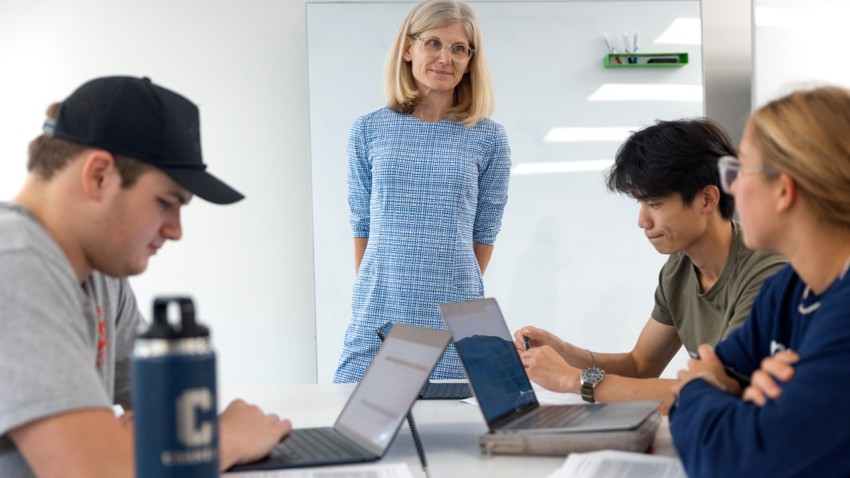
After a successful pilot launch in the spring, Cornell’s AI Critical Literacy Program will be offered in the fall to all incoming students as well as other interested students, faculty members and staff.

Strike a pose: Creating more realistic multi-person images

A Cornell research group has devised a way to generate an image of multiple people, incorporating the poses of all individuals to inform the image generation and make the scene more believable and accurate.

Weak AI regulation may backfire, making products less safe

A new modeling study finds no regulation of AI products and services may be safer than weak regulation.

Inside baseball: AI-enabled enforcement tech takes time, testing

Training artificial intelligence to enforce even seemingly straightforward rules – like balls and strikes in Major League Baseball – is a messy, dynamic process that takes time and careful evaluation of the technology.

‘Moonshot’ project aims to restore trust in the digital public sphere

Researchers have received a seed grant for $250,000 and a chance at a $10 million award to support a project aimed at using artificial intelligence to establish a foundation for trustworthy AI-mediated communication across online platforms.

Avina cofounders and Cornell Tech alumni Michael Wang, Ron Fisher, and Vivek Sudarsan

Via:

Cornell Tech alumni close $3.2 million seed round for Avina

November 15, 2024

Ron Fisher ’16, founded Avina with partners Michael Wang ’16 and Vivek Sudarsan ’16, all three of whom are graduates of Cornell Tech.

An overhead shot of the Cornell Tech Campus

Via:

Cornell Tech’s economic impact on NYC to double by 2030

November 13, 2024

A new analysis finds that Cornell Tech, its alumni and its 115 startups achieved $768 million in total economic impact and supported 2,800 jobs in New York City in the 2023-24 fiscal year.

A color graphic showing stock market numbers

Via:

New statistical method powers research on health, climate, financial data

November 12, 2024

Machine learning and artificial intelligence wouldn’t be possible without the statistical models that underpin their analytic capabilities. A Cornell statistician and his colleague have developed a revolutionary new method to analyze complex datasets that’s more flexible, accurate and easy to use.

A color photo of Nirbhay Narang ’25 has created smart glasses that use AI to provide transcriptions of conversations in real time.

Via:

Student creates smart glasses for people with hearing loss

November 8, 2024

Nirbhay Narang ’25 has created smart glasses to help people manage this situation. The glasses use AI to provide transcriptions of conversations in real time, which can be viewed both on the glasses and on a phone.

The Schmidt Sciences logo in color

Via:

Researchers in climate science, nanoparticles among 12 newest Eric and Wendy Schmidt AI in Science Postdoctoral Fellows

November 7, 2024

Nanoparticles that could change material science. Better models to predict the potential for global carbon offsets. More efficient and cheaper solar panels. These are some of the research projects from 12 of the newest Eric and Wendy Schmidt AI in Science Postdoctoral Fellows from Cornell.

A color graphic showing the concept of AI sustainability

Via:

AI for Sustainability Visiting Professorship launches at Cornell

November 7, 2024

The AI for Sustainability (AI4S) Visiting Professorship has launched at Cornell, designed to bring faculty scholars from across the world to the university to tackle pressing global challenges in sustainability through the power of artificial intelligence.

Credit: Shutterstock Alt: an graphic illustration showing virtual reality avatars in augmented reality

Via:

Disclose invisible disabilities in social VR? It depends

November 6, 2024

Social virtual reality games and apps such as VRChat, AltspaceVR and Rec Room are immersive 3D experiences that let people with disabilities – both visible and invisible – try activities that might not be available to them in the non-virtual world.

In those settings, Cornell researchers have found, the decision to disclose an invisible disability – a physical, mental or neurological condition that is not visible from the outside but can limit or challenge a person’s movements, senses or activities – is personal.

A color photo showing a person apply for a job on their computer Credit: McLittle Stock, Shutterstock

Via:

New algorithm picks fairer shortlist when applicants abound

November 4, 2024

Cornell researchers developed a more equitable method for choosing top candidates from a large applicant pool in cases where insufficient information makes it hard to choose.

While humans still make many high-stakes decisions – like who should get a job, admission to college or a spot in a clinical trial – artificial intelligence (AI) models are increasingly used to narrow down the applicants into a manageable shortlist.

A color photo of Sendhil Mullainathan

Via:

Visiting lecturer will explore expanded vision for AI in research

November 4, 2024

Polymath scholar Sendhil Mullainathan ’93, a behavioral economist who has combined computational and social sciences to produce pioneering work on health care, poverty and the criminal justice system, will deliver three public lectures at Cornell Nov. 11-13 for the Messenger Lectures series.