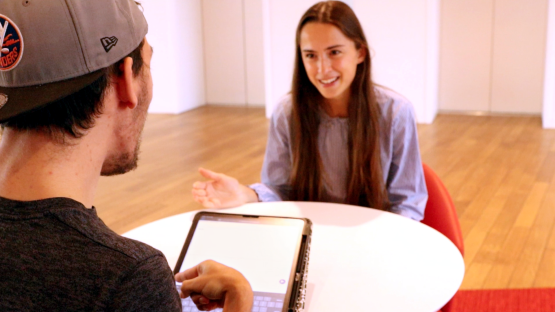
Researchers who develop social robots – ones that people interact with – focus too much on design features and not enough on sociological factors, like human-to-human interactions, the contexts where they happen and cultural norms involving robots.

News Category
News

Researchers who develop social robots – ones that people interact with – focus too much on design features and not enough on sociological factors, like human-to-human interactions, the contexts where they happen and cultural norms involving robots.

We live in an era in which rapid technological change shifts the global security balance in real time. No one knows that better than Sarah Kreps, director of the Brooks School Tech Policy Institute (BTPI), and John L. Wetherill Professor in the Department of Government in the College of Arts & Sciences.

Empire AI, a $400 million effort to create a shared academic research computing facility, is set to advance dozens of ambitious, cross-disciplinary projects at Cornell.

Beginning Fall 2024, Cornell undergraduates can minor in artificial intelligence (AI).

Yu Jiang is taking ag research to the next level. From robots to drones to AI, Yu is developing many exciting solutions for the New York farm industry.

Cornell researchers are part of a project to enable sustainable hardware for AI and quantum computing, one of 11 projects selected by DOE to receive a total of $73 million.

A team of Cornell computer scientists has been awarded a $3 million grant from the Defense Advanced Research Projects Agency to leverage reinforcement learning to make computer networks stronger, dynamic and more secure.

Researchers tracked the brain’s dopamine reward system and found – for the first time – this system flexibly retunes toward the most important goal when faced with multiple competing needs.