
The Assessing and Imagining the Impact of Generative AI on Science Symposium, March 3-5, will feature experts from across academia and industry engaging in discussions on the use and implications of generative AI.
News Category
News
The Assessing and Imagining the Impact of Generative AI on Science Symposium, March 3-5, will feature experts from across academia and industry engaging in discussions on the use and implications of generative AI.

The Assessing and Imagining the Impact of Generative AI on Science Symposium will feature diverse experts from across Cornell, academia and industry engaging in discussions of how GenAI is being used in research, and the implications for policy, funding and the public trust.
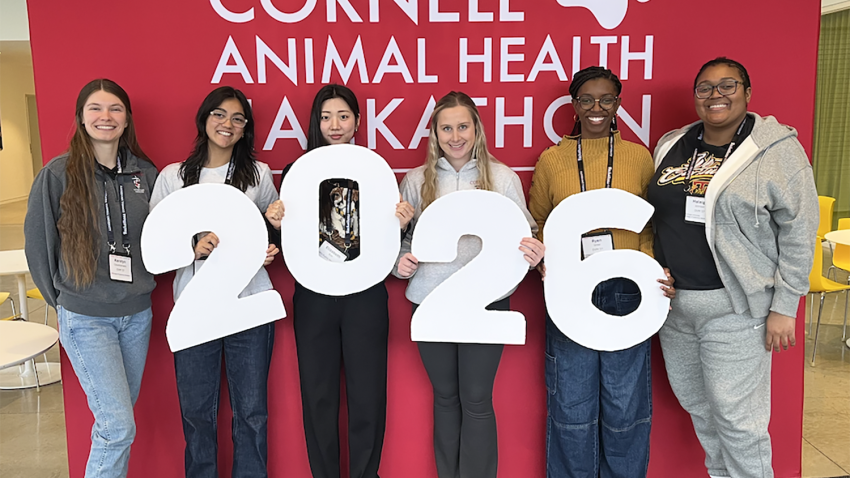
Products to fight ear infections in dogs, a parasite in cattle and animal population control challenges won top honors at the Feb. 20-22 Animal Health Hackathon at the College of Veterinary Medicine.
Founded by Rene Kizilcec roughly seven and a half years ago, the Future of Learning Lab studies the intersection of technology, education and learning science across all age groups, from primary through post-secondary. The lab’s projects span a variety of application areas, from a national database of tutoring interactions to artificial intelligence powered clinical training tools deployed at medical schools across the country to a language-learning platform used in Cornell’s own classrooms.

As generative AI becomes a dominant gateway to information, we risk losing something far older and harder to replace: the local knowledge, cultural memory, and lived expertise that never makes it into training data. In a new commentary, Deepak Varuvel Dennison, a Ph.D. student in Information Science in the Cornell Ann S. Bowers College of Computing and Information Science, warns that this shift could trigger a global “knowledge collapse”—and that we’re only beginning to understand what’s slipping away.
In an effort to unify the rapidly expanding set of academic activities investigating artificial intelligence (AI), Weill Cornell Medicine is launching a new AI to Advance Medicine initiative. Encompassing a Dean’s Lecture Series and Dean’s Grant Program, the...

A new artificial intelligence framework developed at Cornell can accurately predict the performance of battery electrolytes while revealing the chemical principles that govern them, providing engineers with a new tool for designing better batteries.
Cornell’s Center for Data Science for Enterprise and Society and Cornell’s Artificial Intelligence Initiative are sponsoring a Call for Proposals for THOUGHT SUMMITS, a Cornell forum aimed at identifying and developing inter- and intra- institutional collaborations in the novel areas of Data Science and Artificial Intelligence.