• Chemistry-Accelerated Machine-Enabled Learning (CAMEL): From Theoretical Understanding and Design to Experimental Interpretation and Discovery

    www.youtube.com/@AIMaterialsInstitute

    Machine learning is transforming materials discovery, but its greatest impact may come not from applying general-purpose AI to materials data, but from constructing learning methods that embody chemical and materials-physics knowledge. I will illustrate this through interpretable representations; differentiable design using Effective Atom Theory (EAT), differentiable Equiformer fast EAT (DEFEAT), and hereditary EAT (HEAT); Bayesian interpretation of experiments; and closed theory–experiment loops. Demonstrated applications span superconductors, photovoltaics, clean-energy catalysts, ptychography, and superconducting qubits.

  • Cornell at Climate Week NYC

    New York City

    Cornell researchers return to New York City for Climate Week NYC 2026 from September 20-27, joining global leaders to advance bold, science-based solutions to pressing sustainability challenges.

  • AI and Accessibility Summit 2026

    Cornell Tech campus 2 W Loop Rd, New York, NY, United States

    The AI and Accessibility Summit is CATAI's annual conference on accessibility — spanning research, identity, and policy. The goal is to bring together voices from within Cornell University (faculty, staff, students, and alumni) and to build lasting connections with organizations in and around New York City. The 2026 edition takes place on September 22 and 23, 2026 and runs over two full days. Day 1 is fully in person and open to everyone who registers, with keynotes, talks, panel conversations, and hands-on demos. Day 2 is a smaller, invite-only day built around case study discussions, alongside a handful of talks — a chance to […]

  • Talent Acquisition and Employee Mobility

    Cornell University, Ithaca, N.Y. Ithaca, New York

    This CAHRScast session will explore how AI is being used in talent acquisition and employee mobility, including emerging applications, decision points, and implications for organizations and employees.

  • Ask the Statisticians: AI in Scientific Research

    Zoom

    The capabilities of AI has dramatically increased over the past year. This session will provide a space to discuss innovative ways researchers across departments are integrating AI into their statistical workflows, as well as a space to discuss concerns about the best ways to maintain the scientific rigor and reproducibility in the process.

  • AI and the American Workforce: A Briefing on the Future of Work

    U.S. Capitol Visitor Center, Room SVC 215 Washington, DC

    Learn how artificial intelligence is reshaping the American workforce at an upcoming briefing sponsored by Cornell University and the R Street Institute. Artificial intelligence is transforming how Americans work — automating routine tasks, creating new categories of jobs, and demanding new skills across nearly every sector of the economy. From manufacturing to farming to government agencies, AI adoption is accelerating faster than traditional training and educational systems are capable of preparing current and future workers. Understanding AI's impact — analyzed by researchers, employers, and policymakers nationwide — is essential to ensuring American workers can adapt to the jobs of the […]
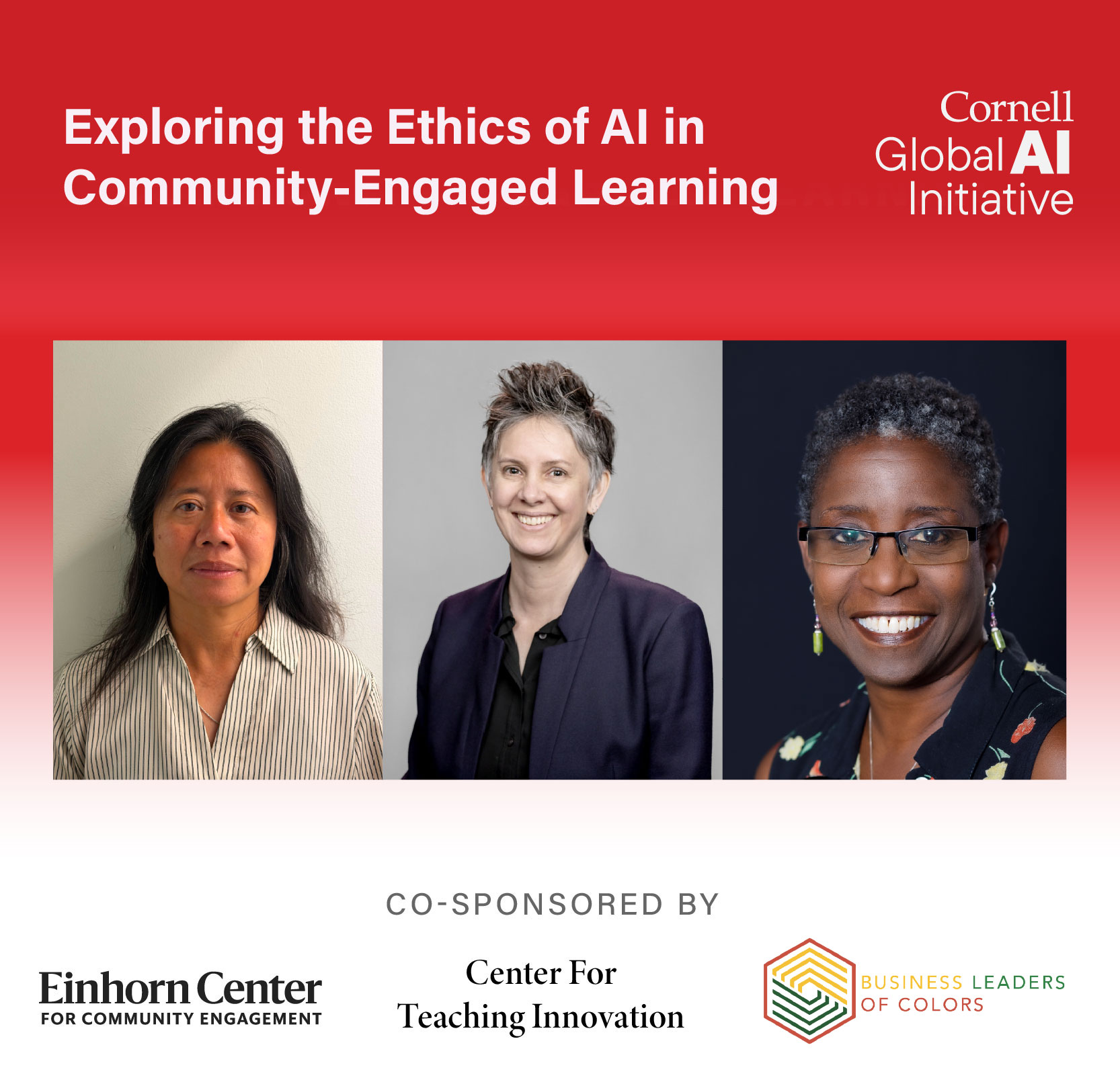
  • Global AI Seminar: Vyoma Raman

    Gates 203 | Virtual via Zoom

    Vyoma Raman is a PhD student in Information Science at Cornell Tech / Cornell University.