
CoPAIR provides researchers with access to emerging AI tools, training, and collaborative communities where they can learn and share best practices, develop disciplinary norms, and evaluate them.
What is CoPAIR?
Communities of Practice for AI-enabled Research (CoPAIR), co-sponsored by the Cornell AI Initiative and the Office of the Vice Provost for Research (OVPR), is organized around two pillars: Research Pods and Core-Centers. Each brings researchers together to share best practices, develop disciplinary norms for appropriate AI use and non-use, evaluate emerging AI tools for research, and support collaboration across domains.
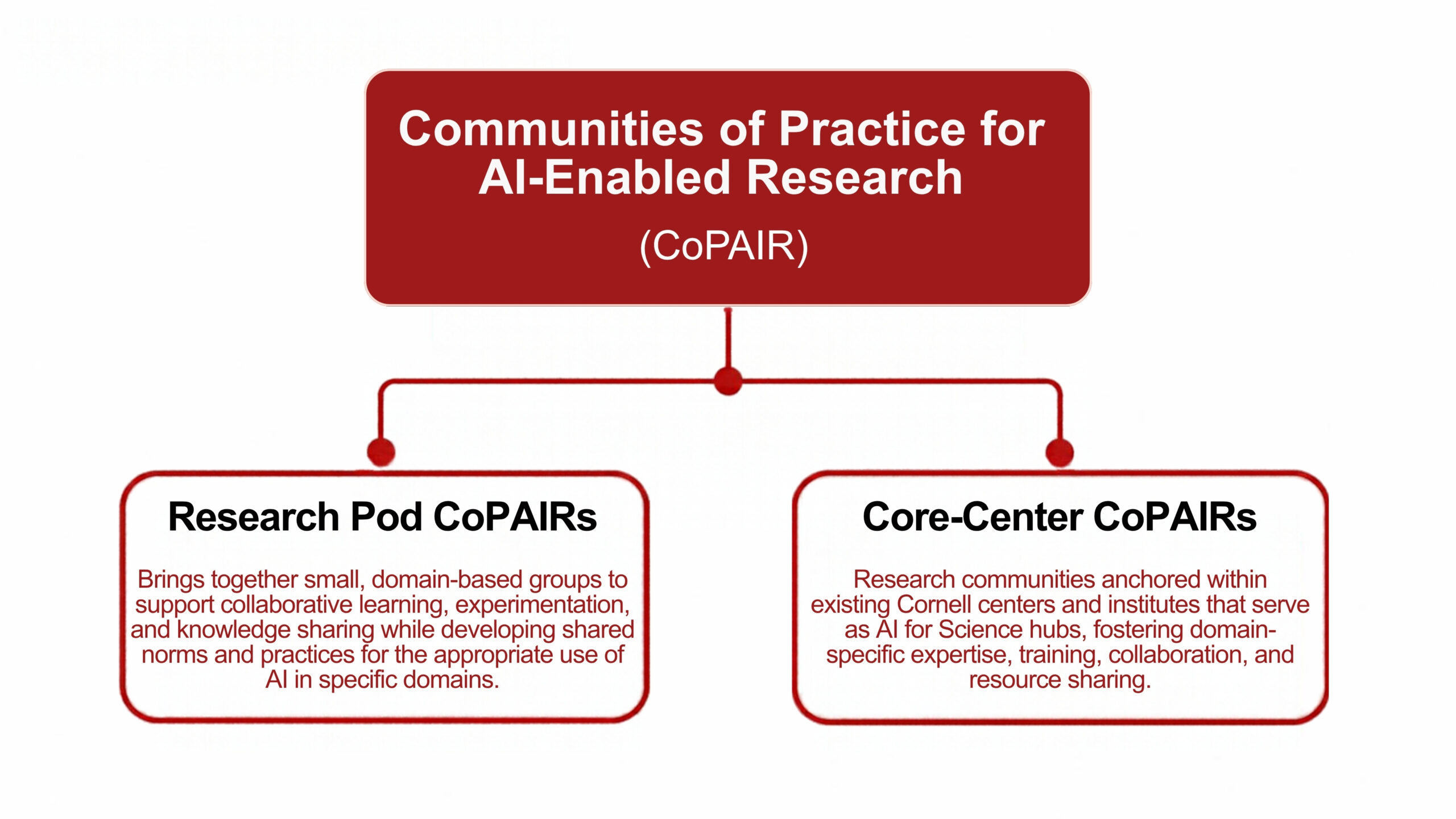
Research Pod CoPAIRs
Research Pod CoPAIRs are small, self-formed groups of researchers who come together to explore questions and practices around AI use for research within their field.
Guided by Cornell’s coordinated “AI in the Disciplines” framework, Research Pod CoPAIRs help researchers develop and share AI strategies, expertise, resources, and research workflows.
Each pod is a collaborative space for researchers to test tools and methods, explore where and how AI can be used effectively, and build practical knowledge relevant to their field. In addition to building collective learning and shared practices within each pod, all pods are expected to share lessons learned and successes with the broader Cornell research community.
Pods will contribute practical insights, effective practices, use cases, templates, and tool evaluations, while also helping identify potential risks and appropriate mitigation strategies to support responsible adoption across the university.
Learn more about Research Pod CoPAIRs
Core-Center CoPAIRs
Core-Center CoPAIRs are research communities anchored within existing Cornell centers, institutes, and shared research infrastructure.
Building on established networks for collaboration, community building, and resource sharing, Core-Center CoPAIRs serve as AI for Science hubs for domain-specific AI expertise, training, and tools.
They curate shared repositories of AI agent skills and use cases, support AI-enabled research through general-purpose frameworks and specialized AI for Science tools, and help researchers evaluate, integrate, and apply AI within their disciplines.
Through experimentation and shared learning, they develop, refine, and disseminate best practices, tool evaluations, and guidance for responsible AI adoption across Cornell.
Fall 2026 BRC CoPAIR Pilot
The Biotechnology Resource Center (BRC), a hub for Cornell's biotechnology and life sciences community, is leading the first Core-Center CoPAIR pilot. The approximately eight-week pilot focuses activities around four areas of life sciences research:
- Genomics, including transcriptomics, epigenomics, and metagenomics
- Proteomics and metabolomics
- Imaging
- Structural biology
Working on a large-scale, multi-PI, or cross-disciplinary AI project?
Join our office hours Thursdays at 10 a.m. ET to share your ideas and explore how the Cornell AI Initiative can support you — from connecting collaborators and shaping teams to research development and proposal strategy. For more information, contact Jovana Savanovic, Research Development Director.