
Across disciplines, Cornell researchers advance the foundations of AI while exploring its applications, ethics, and societal impact. Their collaborative work shapes the future of AI and advances its responsible development and use to address real-world challenges.
Three Interlinked Focus Areas
Advancing Foundational Algorithmic Capabilities
Cornell develops new algorithmic capabilities in machine learning, reasoning, perception, language, and actuation to expand what AI can do and unlock new applications and economic opportunities. Researchers advance the core technical foundations that make AI more capable, reliable, and adaptable, enabling progress across disciplines and industries.
Human-AI Engagement
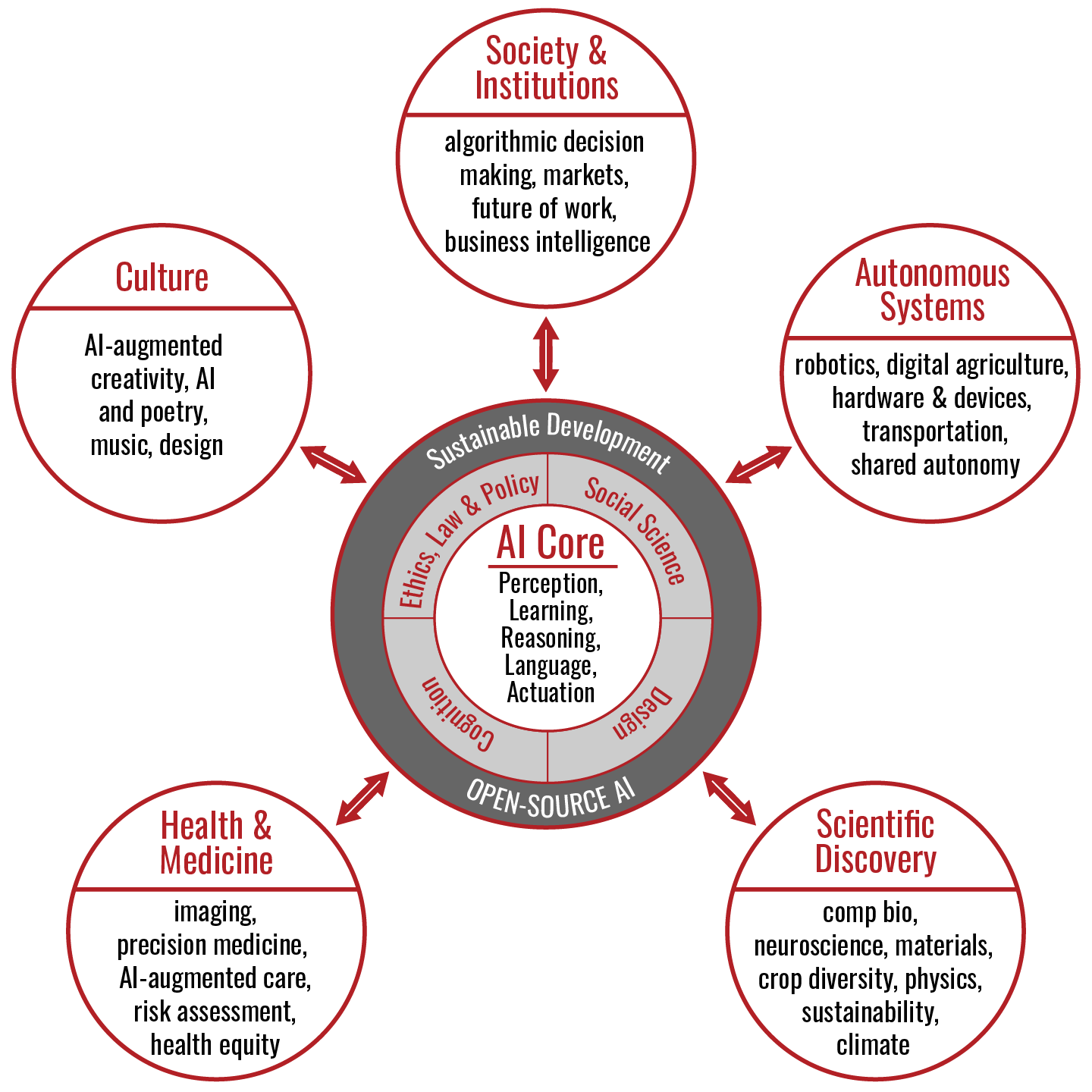
Cornell advances research that informs socio‑technical practice and design by examining how humans and AI interact across individual, group, and societal contexts. Researchers connect technical development with ethics and humanistic perspectives, law and policy, social science, cognition, and design to ensure that AI systems align with human needs, values, and real‑world use.
Application Impact Areas
Cornell brings AI to the world’s most important challenges by drawing on the university’s broad excellence across disciplines. Researchers pursue cross‑disciplinary work in application areas that span society and institutions, autonomous systems, scientific discovery, health and medicine, and arts and culture, ensuring that AI advances are grounded in deep domain expertise and meaningful real‑world impact.
Advancing Foundational Algorithmic Capabilities
Most AI systems require many or all of the following AI algorithmic capabilities:
Machine Learning
Supervised learning, unsupervised learning, reinforcement learning, causal inference, statistics, etc.
Reasoning
Planning, control, multi-agent interaction, knowledge representation, optimization, etc.
Perception
Images, video, depth cameras, sensors, bio-medical imaging, haptics, on-body sensors, etc.
Language
Discourse, sentiment, summarization, speech recognition, translation, question answering, generation, etc.
Actuation
Autonomous robot, medical device, smart city, deep fakes, recommender system, extended reality, etc.
Human-AI Engagement
AI interacts with individuals, groups, and society in ways that extend far beyond traditional computing technologies. As a result, AI systems cannot succeed on algorithmic capabilities alone. Cornell advances research that examines how humans engage with AI and how to design systems that meet human needs sustainably. This work integrates core AI algorithmic development with ethics, humanistic perspectives, law and policy, social science, cognition, and design to ensure that AI technologies are aligned with human values and real‑world contexts.
Ethics, Law & Policy
AI raises new ethical and legal questions that have deep implications on the technology and its use (e.g., algorithmic bias, fairness, privacy, explanations, regulation, national security).
Social Science
AI systems act in the human world and we must understand human behavior in the context of AI (e.g., human bias, human decisions, social behavior, game theory, markets).
Design
We must carefully design AI systems in a complex space of affordances and requirements (e.g., human-robot interaction, interaction design, value-based design).
Cognition
Our understanding of natural intelligence will both inform and be informed by AI (e.g., bio-artificial analogies, cognitive psychology, brain-machine interfaces).
Application Impact Areas
The following application areas combine high potential for AI impact with existing research excellence at Cornell, which provides multiple avenues for recruiting faculty to deepen connections with AI technology:
Society & Institutions
AI is making small and increasingly big decisions affecting retail, political discourse, labor, law, education and many other areas of our society. How can AI be used to strengthen our institutions by improving effectiveness, fairness and transparency?
Autonomous Systems
AI is moving into the physical space that is shared with humans, with new applications in transportation, farming, climate, medicine, manufacturing, assistive technologies and others. How can we build highly reliable and effective physical systems that suitably share autonomy with humans?
Scientific Discovery
AI not only supports the scientific process (e.g., literature analysis), but has shown to be highly effective when optimizing complex objectives with expensive measurements. How can AI more generally accelerate the discovery of new climate interventions, materials, drugs, crops, chemoresponsive sensors, solvents, and other advances?
Health
Newly available data (e.g., clinical, multi-omics, behavioral) and perception capabilities (e.g., imaging) can inform treatment and care. Tele-health provides new opportunities to support physicians, patients and caregivers. How can we bring AI to bear on both precision medicine and improved care?
Culture
Nascent questions have arisen around AI-augmented creativity, neural style transfer, aesthetic feature classification and others. Can AI (and its limitations in art, literature, poetry, etc.) shine new light on what may be uniquely human?
Sustainability
We further assert that sustainability is an overarching goal that can inform the AI technology we build, direct the values this technology embodies, and guide the problems we tackle.
Latest AI News at Cornell
Cornell is spearheading the development and refinement of AI through extensive interdisciplinary collaborations.